Castello del Terriccio might be the best producer of Super Tuscan wine that you’ve never heard of. Founded in the latter 1980s by the late Gian Annibale Rossi di Medelana, the estate has gone through a period of upheaval since his passing.
But let’s rewind the clock….
The Castello del Terriccio Estate dates back to the late 1970s. At the time, the property was mainly a farm for raising cattle and agricultural crops. By the time Gian Annibale acquired the estate, the Bordeaux craze in Bolgheri had firmly taken hold and Gian was determined to make great wine in Italy.
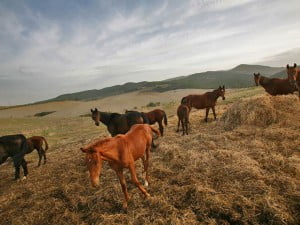
~ The estate was once home to over 50 show horses ~
As a result, Gian sought out and retained the renowned viticulturist Carlo Ferrini to oversee production of premium Bordeaux blends. Success was immediate. Bolgheri had a new neighbor. Terriccio had come to the Alta Maremma.
1993 was the first commercial vintage for Terriccio. Using Sassicaia as the barometer, Lupicaia was born. The impact was seismic as the debut received the coveted “Tre Bicchieri” award from Gambero Rosso. The horse farmer was off to the races.

The following year, Ferrini created Tassinaia further cementing the estate’s footprint as a producer to be reckoned with. That wine received Due Bicchieri. At the time, Tassinaia was a blend of 34% Sangiovese, 33% Cabernet and 33% Merlot but modern vintages have removed the Sangiovese.
Today, the estate is overseen by Vittorio Piozzo di Rosignano Rossi di Medelana, (Vittorio) the only nephew of the late Gian Annibale, who works in partnership with longtime enologist Carlo Ferrini, to uphold his uncle’s vision.
Vittorio has undertaken a two pronged approach after assuming the helm at Terriccio. After Gian’s passing in 2019, Terriccio lost their US importer amid the chaos of Covid-19. Subsequently, the winery was shipping into the US on a DTC basis. So, the first order of business was to rebuild that channel and he has done a great job doing that. Terriccio is now handled by Vias Imports in NYC.
The second prong has dealt with transforming the estate itself. As you will read below, the property is being modernized into a Tuscan oasis within sight of the sea. A vibrant “estate hamlet” where guests can relax and recharge amidst great wine and food.
For this piece, I reviewed the latest vintages of Tassinaia and Lupicaia. I’ve also received a cellared version of Lupicaia that’s been housed at the estate since release; the 2010. And, just recently I received the estate’s newest wine, Gian Annibale. I will include that wine in an upcoming Tuscan Snips. Let’s get to it!
Wine Reviews
The 2021 Tassinaia is a beautiful shimmering violet color in the glass. I did not decant the wine and it certainly did not need it. Straight away the aromas are spellbinding. Crushed stones, black fruits, hints of roasted coffee and nuts combine seamlessly. On the palate, this 50/50 blend of Cabernet and Merlot is a gem. While it is round and seductive, it’s flavors of black plums, stones, salinity, dark cocoa and leather speak with an unmistakable Italian accent. For me, it’s a delicious wine that punches above it’s weight class and is a value that can be opened and enjoyed. 93 points. Find this wine.

~ A lovely blend of Cabernet and Merlot ~
The 2010 Lupicaia is an opaque, very dark purple. There is no indication whatsoever that the wine is 15 years old by looking at it. A blend of predominantly Cabernet with Petit Verdot, the wine is sourced from two vineyards named “Lupicaia” for Cabernet and “Addis” for the Petit Verdot. Both vineyards are full of heavy rock, calcareous soil and limestone which lend structure to the wine but also impart varying levels of minerality.
The wine was brought to a local steakhouse where the sommelier happily decanted it for us. On the nose, this wine is special. I remember thinking at the time, more people should know about this wine. Dark fruits, worn leather, blue flowers and rosemary aromas are attractive. On the palate, the wine is more indicative of its age than the color presents. Softened black fruits are framed nicely by resolved, powdery tannins. Baking spices, trampled underbrush and scrub herbs provide complexity proving that while this wine may not need much age, it certainly is capable of becoming intriguing with it. I may have preferred this more a few years ago, but that’s just my preference. 92 points. Find this wine.
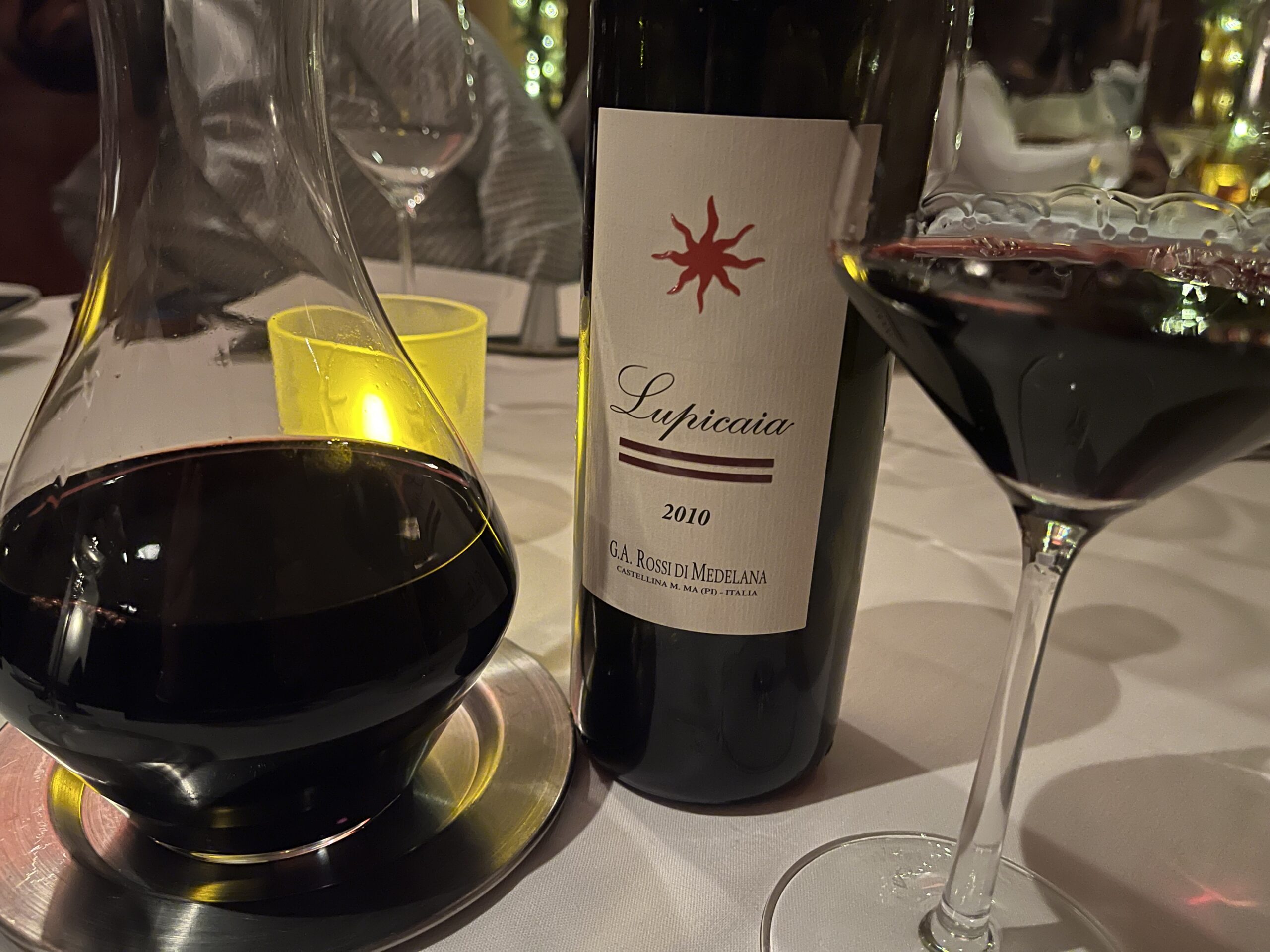
~ 15 years old and in peak drinking window ~
Now we’ll fast forward to the most recent release of Lupicaia.
The 2019 Lupicaia is, like its predecessors, a blend of Cabernet with Petit Verdot. If I had to provide an analogy for those familiar with the Bolgheri/Maremma style, I would say that Lupicaia (Wolf’s Hill) is a hybrid of Sassicaia and Ornellaia. To me, it’s more enjoyable than Ornellaia and fits stylistically between the two.
The color is dark and spectacular. Immediately open on the nose, the taster is greeted by primary black fruits backed with toasted spices, Christmas cake, new leather and even hints of red flowers. On the palate, this is a gorgeous Cabernet with intricately woven tannins that allow this to drink now. Crushed black fruit, crushed stones, coffee, hints of mineral and a wonderfully long finish mark this elegant wine. It’s fresh, juicy and the acidity perfectly balanced giving this Super Tuscan a decidedly Italian nod. I can’t say enough about this. It puts more expensive wines to shame. 96 points. Find this wine.
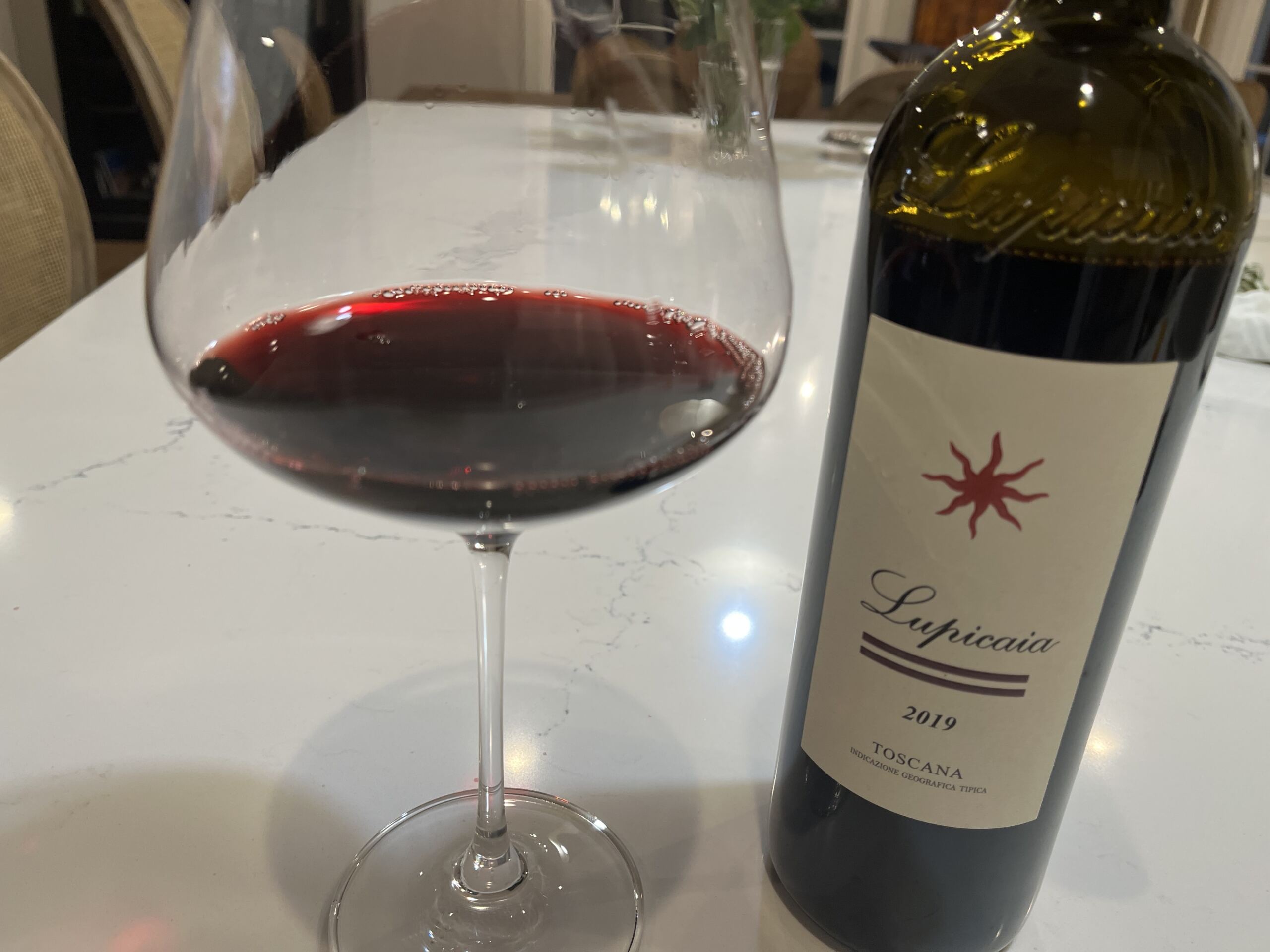
~ Lupicaia is a seriously underrated wine ~
Interview with Estate Owner Vittorio Piozzo di Rosignano Rossi di Medelana
And now, I am pleased to introduce Vittorio, who will update us on the news of Castello del Terriccio.

TV – Welcome Vittorio, congratulations for achieving the excellent vision you have for Castello del Terriccio and grazie mille for joining us today.
Grazie a te, Giovanni. It’s a pleasure. We are working hard, yes – but the full vision is not yet realized. We have more good work to do.
TV – From my original article, I noted that the estate once housed over sixty show horses. They were a passion of Gian’s — do they still remain on the property?
Horses have always been a profound passion within our family. My grandfather was a cavalry officer, and my uncle, Gian Annibale, was shortlisted as a potential Olympic candidate. It was, tragically, while riding that my uncle suffered an accident which confined him to a wheelchair at the age of thirty-eight.
Yet he never allowed adversity to dampen his spirit: he continued to pursue his love for horses through breeding, and following the accident, he also devoted himself to the production of the wines of Castello del Terriccio, paving the way for what Castello del Terriccio is today.
I personally chose to retain only a small number of horses, opting not to continue the breeding activity, so as to fully concentrate on wine production and on the enhancement and restoration of the historic buildings that form part of the Castello del Terriccio estate.
TV – Vittorio, you are Gian’s nephew and now control the estate. Do you play any role in the winemaking? I also know that Carlo Ferrini has remained the estate’s “consultant” since the early 1990s. Is he the principal oenologist behind the red wines?
Si, I am Gian Annibale’s nephew, and since his passing I have been fully engaged in the stewardship of Castello del Terriccio, overseeing the estate and all its activities. This includes the coordination and supervision of wine production, while the technical aspects of both viticulture and vinification are entrusted to our oenological team.
Carlo Ferrini has been our consulting oenologist since the early 1990s and, for more than thirty years, has represented a fundamental point of reference for our wines. He works in close collaboration with our estate oenologist, Valerio Corsini, and our agronomist, Emanuele Vergari, who together manage the daily work in the vineyards and cellar.

~ A country road on the Estate ~
TV – Ferrini’s clients are widely regarded as icons of Tuscan wine (San Leonardo among them). How important is it to have him on board?
My uncle Gian Annibale began his collaboration with Carlo Ferrini over thirty years ago. Today, Carlo has a profound knowledge of every single vineyard, of how each parcel expresses itself across vintages, and of how the wines will evolve over time. His personal experience and deep understanding of Castello del Terriccio are invaluable, allowing us to craft wines that are modern and elegant, yet unmistakably rooted in a strong sense of place and territorial identity.
TV – Let’s talk about the wines for a bit. Who conceived the vision behind the new wine dedicated to Gian Annibale? Was it your idea or Carlo’s? What is the production level? With Ferrini still involved, do you perceive a stylistic difference between today’s wines and those made under Gian Annibale? For instance, does Lupicaia 2010 differ stylistically from the 2019 vintage?
This is a good question. When I assumed leadership of Castello del Terriccio, I felt a deep desire to create a wine in honour of my uncle, Gian Annibale. I shared this idea with Carlo, who embraced it immediately and with genuine enthusiasm. The wine we conceived is a distinctive blend composed of 60% Petit Verdot and 40% Cabernet Sauvignon, intended to reflect my uncle’s character. The Petit Verdot used for the Gian Annibale wine comes from a single, isolated vineyard that my uncle had resolutely wished to establish.
Production is deliberately limited, ranging between 3,000 and 5,000 bottles per year, and only in the finest vintages.
The style of our wines has evolved to some extent, yet it remains firmly connected to the past by a clear guiding thread. Together with Carlo, we have worked to ensure that each wine of Castello del Terriccio possesses its own distinctive identity, while offering immediate drinkability, elegance, and the capacity for graceful ageing.
This is the result of a meticulous process that begins in the vineyard and continues through the cellar and the barrel ageing. The wines themselves are blends shaped through extensive tastings involving myself, Carlo, our oenologist, and our agronomist — with Carlo acting as the great conductor, whose vast experience allows him to translate both his vision and ours into the final wine.
TV – Your passion is palpable! As is your respect for Carlo and the experience he brings in shaping the wines. I remember that Sangiovese was once included in the blend for Tassinaia — when did that change? It was also the main grape in the entry level red Capannino. Is Sangiovese still cultivated on the estate? Has Capannino been discontinued? Do you also grow Vermentino?
Sangiovese has no longer been produced on the estate since 2008 and has therefore not been part of the Tassinaia blend since that time. Today, Tassinaia is composed of 50% Cabernet Sauvignon and 50% Merlot.
Capannino was discontinued in 2015. We have never produced Vermentino; our sole white wine, Con Vento, is a blend of Viognier and Sauvignon Blanc.
~ The new Ristorante at Castello del Terriccio is led by Michelin star winning Chef Cristiano Tomei ~
TV – Let’s talk about the state of things now. In your view, what is the greatest challenge facing Castello del Terriccio today?
The greatest challenge for Castello del Terriccio lies in continuing to evolve while remaining faithful to its identity and history. This includes opening the estate to hospitality, restoring its ancient buildings to allow guests to experience a deep connection with history and nature, and diversifying and enhancing its activities and productions. In the past, up to five hundred people lived within the estate, forming something akin to a small village — a spirit we seek to reinterpret in a contemporary way.
TV – A while back, I wrote a large article about the changing climate and how it impacts Tuscan winemaking. How is the estate addressing the challenge of climate change?
Climate change is a crucial issue, particularly in viticulture. We are implementing numerous small but meaningful measures to address it: selecting root stocks that offer greater resistance to drought, training vines at a greater height above the ground to mitigate soil heat, rethinking vineyard exposures, carrying out targeted leaf thinning to ensure ventilation while still protecting the grapes with shade, and advancing harvest dates, among many other adjustments. These practices do not artificially alter the natural balance of the vine, but rather support and preserve it. And the vines always adapt.
TV – That is what I have always been told- that the vines, like people, adapt. They don’t like to be shocked suddenly, but are resilient in their ability to adjust to different conditions. I find it interesting that you mention the height with which you train the vines. I have not heard that before but it certainly makes sense.
Yes, it’s very true what you say. Many other adjustments are used too. Things like water retention in reservoirs, multiple harvests, sometimes even in the same vineyard. It’s all about adaptation.

~ The Estate lies within sight of the sea ~
TV – Beyond the creation of the new restaurant and Agriturismo, what other developments are underway? Vittorio, what would you most like my readers to understand about Castello del Terriccio today?
I want entering Castello del Terriccio to be perceived as a journey into a world unto itself — one of history, agricultural culture, and nature — offering an evocative and authentic experience.
To this end, we are deeply committed to the restoration of the estate’s historic buildings through careful, respectful interventions that honour their past while assigning them new, contemporary functions. Among these is Villa La Marrana, a guesthouse created from the restoration of the former stables; Terraforte, our restaurant — now included in the Michelin Guide — born from the renovation of the estate’s old carpentry workshop and focused on dishes crafted from ingredients produced on the estate; the bakery laboratory, restored from the ancient wood-fired oven, where bread, focaccia, and biscuits are made using flours largely derived from estate-grown grains; and the historic granary, with its vast panoramic terrace overlooking the countryside, the sea, and the islands of the Tuscan archipelago, now dedicated to events and weddings.
More broadly, the restoration of the borgo continues, making it increasingly accessible and welcoming to our guests. All of this complements our long-established production of wines and olive oil, allowing us to offer a truly complete and immersive experience.
TV – That sounds absolutely passionate and amazing! Many producers are creating Borgos these days so that wine travelers have more options for staying. In your case, being that you are “off the beaten path” a bit, that is a welcome addition. I look forward to visiting and staying! Grazie again Vittorio and we will be following along.
Grazie a te Giovanni – Aspetto a Castello del Terriccio!